How an LAPD Officer Kept a Man from Becoming a Killer
In 1971, a gunman held a recording engineer hostage at Sound City Studios in Los Angeles. The cop who talked him down — without firing a single shot — was Mike Barrett’s father. What followed over the next 36 years was one of the most unlikely friendships ever told.
The Night Everything Changed
The drummer had been at it for four nights straight. A studio engineer had been with him the whole time at Sound City Studios in Van Nuys, California — feeding tape and pushing buttons while a driving percussion track bounced off the cedar-paneled walls. The complex Afro-Cuban rhythms made the drummer’s head spin. He loved this music. It was its own class of intoxicant.
On this particular morning, the tempo started to mix with the acid he’d taken, and something foreign and raw inside him began to boil. The recording session was over, and the engineer asked for payment before handing over the reel-to-reel tape. The drummer’s drug-addled brain whispered things about distrust and disrespect. Within minutes, he picked up a .357 Magnum revolver, took the engineer hostage, and changed one family forever.
Sound City was only a few years old in 1971, but Neil Young had already recorded there. Fleetwood Mac and Elton John would soon tape there too. The studio and its storied soundboard would later be the subject of Dave Grohl’s documentary, Sound City. On this morning, the engineer on the overnight shift was a 21-year-old named Gary Brandt.
The Call
The drummer — Franklin Edward Hoffman, 28 years old that day, a cousin of Dustin Hoffman — called the Van Nuys Police Station. He told the operator his music had been stolen. He was transferred to the watch commander on duty.
“Sergeant Gary Barrett,” the officer said. “Can I help you?”
That cop was Mike Barrett’s father.
With a baritone voice and a cadence like a 1970s anchorman, Sergeant Barrett pressed the red button on a RadioShack cassette recorder he’d happened to bring to work that morning and began to listen. Hoffman told him it was his birthday. He told him he felt, for the first time in his life, like he had become a man. Then he made his position clear: “If my Uncle Harry does not walk in… this young man is going to meet his maker.”
Sergeant Barrett stood up fast, sending his chair crashing backward. He shouted commands to the officers around him, scribbled the studio’s address on a yellow notepad, and within minutes had four black-and-whites and six officers surrounding the building. But it was Barrett — back at the station — who kept Hoffman talking.
An Hour on the Phone
For almost an hour, the cop and the gunman talked. They discussed music, Vietnam, the Apollo missions, poverty, civil rights, and religion. Hoffman had played percussion with the Dillards. He’d co-produced albums and managed bands. Music had always been there for him. Barrett felt much the same — as a child he’d found comfort singing in choirs and playing guitar; as an adult he loved opera, classical, and folk.
Through the phone line, a camaraderie developed. Temporarily, it served to keep all the bullets in all the guns.
Then Hoffman fired a shot — into a filing cabinet next to his hostage. The crack of the gun exploded over the phone. Every cop in the squad room ducked. Ten seconds of silence followed. Then Hoffman came back on: “I did not shoot this beautiful child of God.”
His supervisor made a decision: send Barrett to the scene.
Walking to the Door
Before leaving, Barrett made Hoffman a promise — and asked for one in return. He told Hoffman he’d come to him directly. No bullhorn. No distance. Hoffman warned him what he looked like. Barrett didn’t hesitate: “I think we’ll look like brothers.”
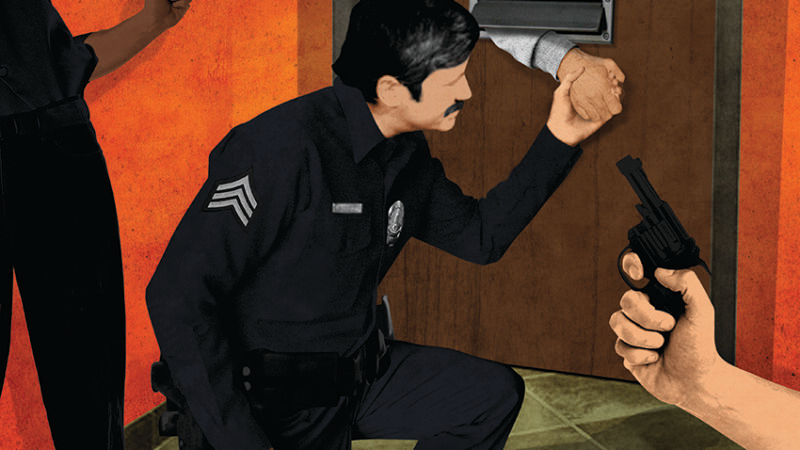
Twelve minutes later, Barrett arrived. He tried the bullhorn briefly. Hoffman screamed at him to shut it off. Barrett tossed it and walked alone toward the studio door — a door he knew was like paper to a .357-caliber bullet. Every cop on the scene, every member of the press, every piece of brass was watching.
Through the mail slot, Hoffman asked Barrett to recite the Lord’s Prayer and Psalm 23 with him. Then he asked him to kneel. A small, shaky hand pushed through the mail slot from the inside. Barrett reached for it and held on — gentle but firm.
The LSD-using Jewish hippie and the conservative Christian cop prayed together on their knees. When they finished, Hoffman asked quietly: “Did I say it right?”
Barrett’s captain answered over the phone: “Perfectly. I never heard it better.”
One by one, Hoffman passed his bullets through the mail slot. He opened the door. He handed over the gun. It was over.
36 Years Later
Franklin Hoffman was convicted of misdemeanor false imprisonment and weapons charges and served only a few months in jail. Exactly one year after the incident, he called Sergeant Barrett at the station to thank him. It became a ritual — every year, at least once, Hoffman would call. Barrett always answered.
Over five or six more years, the calls grew longer. A friendship emerged. Eventually, Mike’s mother, Marianne, invited Franklin over for coffee. Then for holiday dinners. Then, in November 2006, when Barrett was diagnosed with multiple myeloma — an aggressive cancer that breaks the bones from the inside out — Franklin packed up his Jeep Cherokee and drove straight through from Los Angeles to Oregon.
He helped Barrett to the bathroom. He went to the store. He cooked him food. He made him laugh.
Gary Barrett died just before midnight on Christmas Eve 2007. The first call the family made was to Franklin Hoffman, who cried, lit a candle, and said a prayer.
What This Story Teaches
Mike Barrett watched all of this unfold across the span of his life — from a nine-year-old boy at the Hollywood Palladium watching a Medal of Valor draped around his father’s neck, to a middle-aged man watching two old friends pray and weep together in an Oregon hospice room.
This story is about what becomes possible when we choose empathy over force. When we stay in the room instead of reaching for the weapon. When we decide that the person in front of us — no matter how dangerous, how different, how broken — is worth the effort of connection.
That is the talk Mike brings to every stage. Not a theory. A true story. One that took 36 years to fully tell.